
Journalism’s war problem – what to do when we need you
The author of this piece — Emmet Brett (a pseudonym used for the author's personal safety) — is a British national who volunteered for the Armed Forces of Ukraine and served for a year and a half. In this text, he shares his reflections on the war and the recruitment process from the perspective of a foreign volunteer veteran.
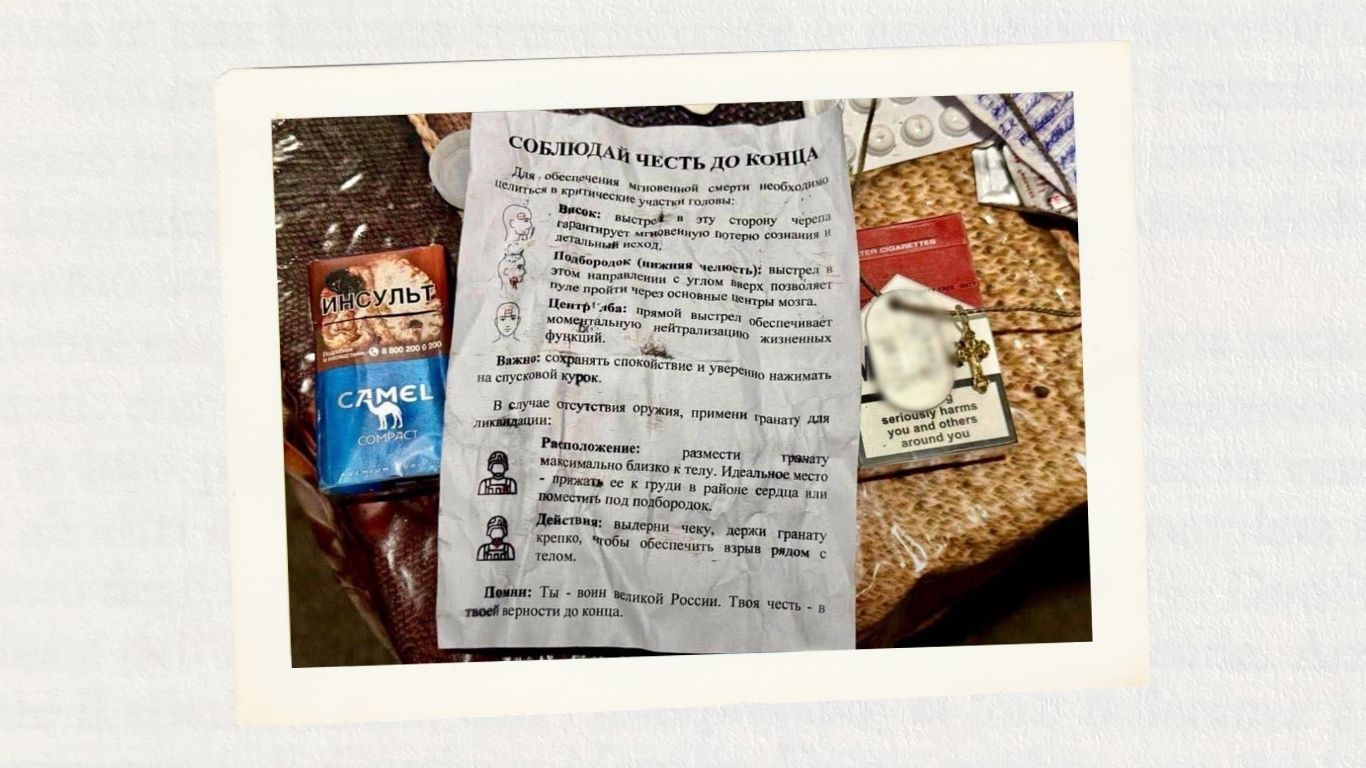
Photo: Russian suicide instructions, taken by a member of the author’s brigade after a Russian position was captured.
I was recently asked to be interviewed for the British podcast Ukraine: The Latest about my year and a half in the Ukrainian Army. I was reluctant, and my question to the journalist was simple — 'What purpose would the interview serve?' His answer was simpler — 'It would be interesting.”'
I declined the interview — others who have experienced the fighting would understand. The only time I speak publicly about the war is if there is a point – the most obvious being to drive recruitment — but my request to use the interview to further this agenda was quietly denied.
I had hoped to be vocal about the fact that Ukraine needs more soldiers in every role, and while our national armies are kept back for fear of escalation, nothing prohibits foreign individuals from joining the 20,000 men and women who have already enlisted from abroad. Not since the Second World War has a conflict felt so morally clear-cut, or the stakes for democracy greater — this is about much more than Ukrainians defending their independence.
Russia is openly airstriking civilian targets, while sending 20,000 of their own men to their deaths each month, with many more injured. Put those two things together, the implication is chilling — a man of what character are we fighting here? For Putin, his war is about much more than Ukraine’s independence — he seeks to expand Russia’s sphere of influence, and has learnt that today’s democracies are loath to meet aggression with force. By framing democratic governance as weak, he is incentivised to absorb casualties – what democracy could stomach such losses? What he did not account for was our unity.
The UK and France will commit armed forces to Ukraine’s defense in the event of a ceasefire, but commentators like John Bolton see no sign of that happening soon. Rather, Putin is holding out for a military breakthrough in the coming months. As individuals in these nations, we can make our own decisions. One cannot overstate the potential impact volunteering en masse would have. More soldiers would trigger the release of more resources for training and equipment to Ukraine, and that would restore Ukraine’s ability to execute meaningful counteroffensives against a low-morale, mercenary-minded Russian army. It would also create a cadre of experts in drone-centered warfare who could then consult and train their home nations’ armies in the tactics and technologies behind this new grammar of the battlefield.
Free international mobilisation on this scale might also reenfranchise the individual in geopolitics – telling our own governments we need to do more to counter the Russian threat, the UN that it is not being the body we need it to be, and future oppressors that the free people of the world have the will to operate against them unilaterally if push comes to shove. Most importantly, we will show other aspiring democracies that we have their backs…
I did not find a way to say all this on the podcast, and it left me wondering why it was not an option.
Journalism is not meant to have a point — especially not one as blunt as recruitment. Insight is the only goal of rigorous reporting — and objectivity its raison d’être. Good journalism seeks out moral conflict, struggle, or hidden crime, exploring multiple angles — it unpacks worlds we never saw, offers glimpses into a far-away outside, or the inside next door. Recruitment is monosyllabic — 'We Need You.'
Newspapers will often serve politically partisan positions, even wearing party loyalty on their sleeve, but journalism in the West has sworn itself, as I once had, to pacifism, and it is rare to find a respectable journalist endorsing any form of militarism in explicit terms.
There is no end of implicit endorsement — a Russian reading The Kyiv Independent, CNN, BBC, Le Monde, or Der Spiegel would think they had happened upon a conspiracy. A single uniform viewpoint connects most Western media on Ukraine: that Russia is guilty of unprovoked aggression. Collective agreement over a crime is, of course, not propaganda — it is a collective agreement. This is free democratic journalism working as it should.
Condemnation is not recruitment, however, and ‘the implicit’ holds back half the message.
A young man in Berlin was interviewed by CNN on the streets during the December protests against Germany’s new military conscription laws. “By preparing for war, it just brings us closer to it” was his point. While this is one of the causes given for the outbreak of the First World War, the very reason Germany has moved from 80 years of institutionalised pacifism to a war footing today is because of the recognition that, in the face of unprovoked aggression, there is no choice but to fight. The alternative is subjugation. This explicit message needs to be broadcast through advocacy media to prepare other European societies for Russian military action against them.
What needs to happen for our journalists to become advocates of defense?
While current ceasefire negotiations resemble movements toward another Munich agreement, as a society, European leaders appear to be getting ready for another September ‘39. Military readiness alone has the power to deter Russia from renewing its aggression.
Despite the threat and the stakes, few European journalists openly promote national conscription — and none advocate service in Ukraine. The shaky legal ground is given as the reason for the latter — former Defence Secretary Ben Wallace criticised it as 'unlawful' and 'unhelpful' for Foreign Secretary Liz Truss to say she supported Britons who wished to fight in 2022. And yet, in Czechia, where a legal pathway opened up this month for those wishing to fight in Ukraine, no journalists came out with a call for citizens to do so. This reticence recalls my own pacifism before a Russian missile struck an apartment block 200 metres from where I was standing, killing 14 civilians. While a broad implicit support for defensive preparedness exists across the European media landscape, we are no place near the rallying cry media of World War Two. Will that only change when our politicians announce we are at war with Russia? Is there not a world where that is too late?
Journalism boasts a rightful legacy of anti-violence, a commitment to human rights, and to human life, making it a bellwether for a humane society. The values of journalism are necessarily at odds with the mindsets required for war — even a defensive one. It is hard to value individual life when your job is to neutralise combatants on sight. But if analysts are right about the Russian threat, our societies need journalists to demand in no uncertain terms a show of strength on terms that Russia and the autocratic world understand; otherwise, everything our ancestors won for us in the last World War will need to be won again.
The journalists of World War Two viewed their wartime role in terms of inspiration: pride in that which we have achieved as a society, and courage to face down what stands against it. Today we need this again – not to go to war, but to be strong enough to deter it. This is not a new Vietnam, nor Iraq. War has come to Europe again – our peace and rights as free peoples are facing a multi-generational threat, and whether it is to sign up for our own country’s sovereign army, or to join us in Ukraine to fight for theirs, the message might not be comfortable, but it is simple: We Need You.