
Overcoming Barriers of the Past: Highlights from the German-Ukrainian Society’s Gathering

On 26 September, an introductory gathering of the German-Ukrainian Society took place at the Lviv Culture Hub. This public organisation works to strengthen and deepen ties between the two countries.
The Deutsch-Ukrainische Gesellschaft (DUG), founded in 2023 on the initiative of German civil society and co-chaired by German historian Franziska Davies and researcher at the Institute for European Politics in Berlin Ludmyla Melnyk, has set itself the goal of reinforcing our partnership. DUG spreads knowledge about Ukraine in Germany, builds networks and fosters dialogue to support Ukraine in its resistance to Russian aggression.
“Unfortunately, many in German society have only discovered Ukraine now, at the moment it is fighting for survival. This is a result of a long tradition of Russian colonialism. Attention was always more on Moscow, not Kyiv, Lviv or Warsaw. For too long the world was viewed through a Russian lens — not only in politics, but in culture too,”
commented Franziska Davies, German historian, president of the German-Ukrainian Society and author of Offene Wunden Osteuropas (Open Wounds of Eastern Europe) and Die Ukraine in Europa. Traum und Trauma einer Nation (Ukraine in Europe: Dream and Trauma of a Nation), explaining the need behind the initiative.
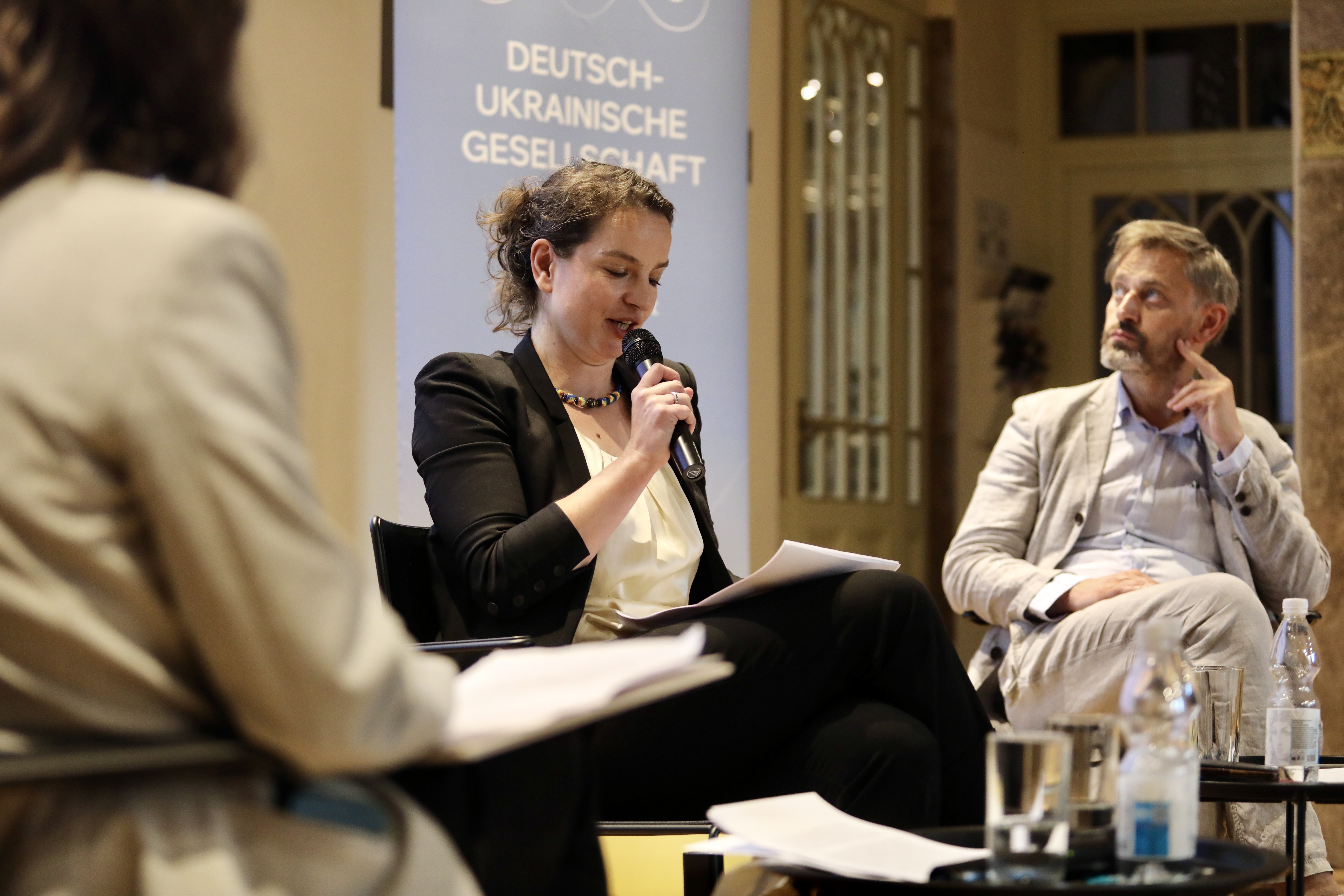
The gathering featured a discussion with Franziska Davies, INDEX programme coordinator and Society's member Olesya Yaremchuk, translator of German literature, Germanist and essayist Yurko Prokhasko and philosopher and translator of German philosophical literature Vakhtang Kebuladze.
The participants reflected on historical contexts and colonial legacies, as well as on various aspects of German-Ukrainian relations from the history of the early 20th century and the consequences of occupation policies to contemporary cooperation in the context of Russian aggression.
The Soviet Union, too, was a form of Russian imperialism, said Vakhtang Kebuladze:
“In Soviet times there was a joke that the USSR was a country with an unpredictable past. In the same way, Russians are constantly rewriting their history to legitimise their crimes and present them as acts of heroism.”

The discussion also touched upon sentiments toward the Soviet Union and the influence of these attitudes, particularly in Eastern Germany.
“When people live for so long within the context of a particular ideology, it becomes part of their identity. This is a special form of imperialism. But these complexes can be overcome,”
added Yurko Prokhasko, speaking from a psychoanalytical perspective.

According to Franziska Davies, the situation has improved considerably since 2022, with parts of civil society now supporting Ukraine.
The participants also talked about the philosophy of understanding, translation as a cultural journey, and the creation of bridges between countries. The discussion ranged from political and cultural interconnections to the challenges of disinformation, Ukraine’s changing role on the international stage, and the defence of the values of freedom, unity and democratic cooperation.
The event also featured experiments with language roles, when the German participants spoke Ukrainian, while the Ukrainian side spoke German.
“In times of overwhelming Russian propaganda, it is crucial to strengthen the partnership between Germany and Ukraine, to deepen ties and to be present in dialogue. For me, it was particularly valuable that our guests from Germany spoke Ukrainian, and our Ukrainian participants spoke German. This is a sign of understanding and of coming closer together on Europe’s mental map,” said moderator Olesya Yaremchuk.

Learn more about the Society and its activities on the DUG website.