
The Trees Are Turning Green Again in Spring
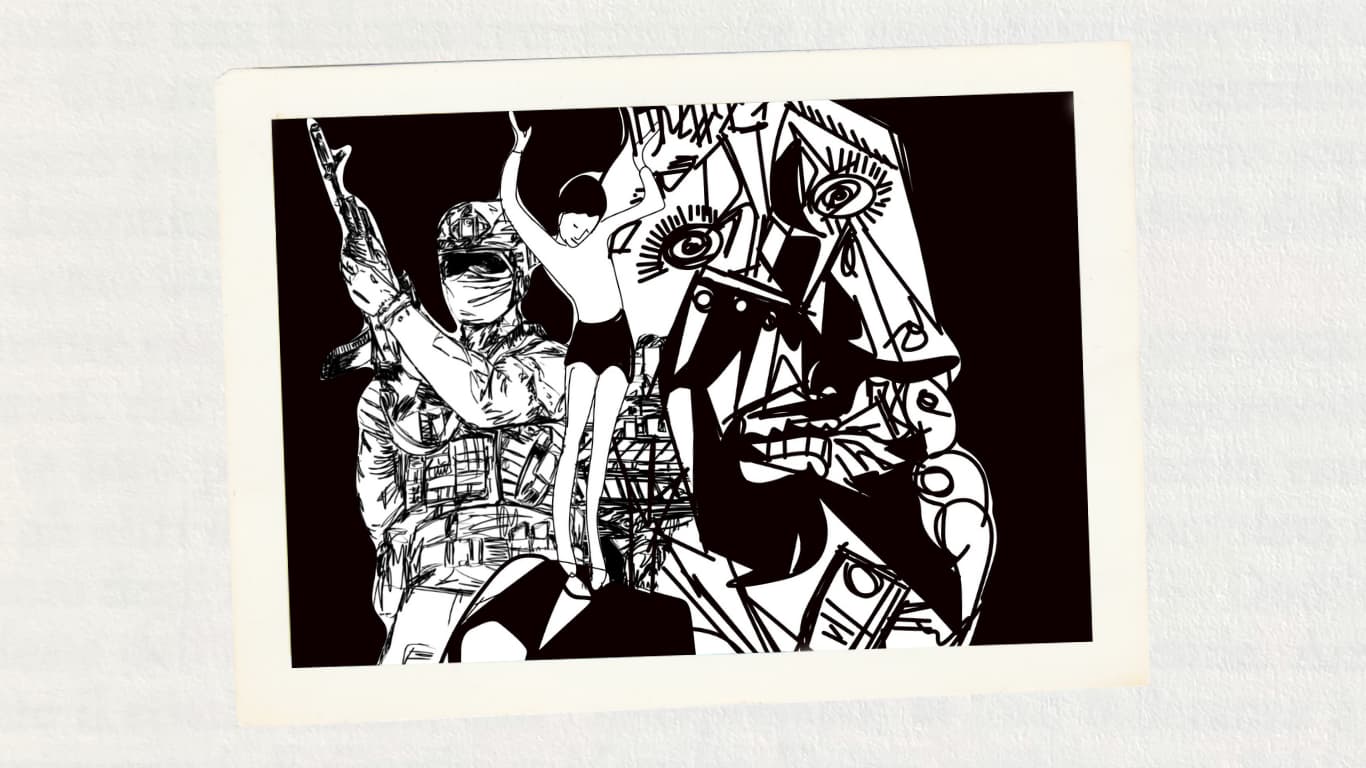
They were planning to rotate Field out. Before he left, I wrote a letter to my wife. Field was going to send it when he left the position and got to frontline Komyshuvakha. He said: I’ll send it by Nova Poshta. Write down the address and phone number, and I’ll take care of it.
At the time, we’d been without phone signal for almost a month. Our families knew we were alive, because we were recording messages for them over the radio. Our commanders were sending them the recordings via messenger apps. Short and to-the-point messages like: we’re alive, we’re well, don’t worry, we love you.
Field had been here the longest—113 days. What was involved in getting out was simple: run to the next position, two thousand three hundred and seventy metres away. I know that was the distance, because we looked on the map.
Field smiled: you know, I’m a bit scared. But I’ve got to try. I promised I’d get out, and I want to see my family.
Everyone wants to see their families.
We had a notebook. I picked it up and started writing. Not because I believed in letters. In war, a letter is like a dry sock, a battery, a cigarette, chocolate or a sweet fizzy drink. A small piece of evidence that another life exists, somewhere. There’s no guarantee that it’ll wait for you, but while you’re writing, it’s as if it exists.
++
I sat in the dugout hole with the sheet of paper on my knee. The pencil was blunt, and the paper was damp at the edges. The explosions were pounding so hard above us that they shook earth loose from the ceiling in small black grains.
Field sat near the entrance, smoking and looking out at the trees.
‘Write,’ he said. ‘I’ll send it for you when I leave.’
He said it in such a matter-of-fact way. As if he wasn’t talking about leaving a position, about the grey zone between us and the rear, where everything that moves comes under fire, but about going into town for bread. That was his style—to talk about terrifying things in an everyday way. Not because he wasn’t scared. He was scared. I could tell by his hands. But he never let fear get the upper hand.
I wrote: ‘Sweetheart’.
And looked at this word for a long time.
It was too pure for our dugout hole. Too clean, perhaps. Too peaceful, definitely. Beside me lay gun magazines, bandages, an empty can of corned beef, somebody’s lone glove, and on the sheet of paper: ‘Sweetheart’, like a small window through which I could see the kitchen, her hair, the light on the windowsill, the chipped mug.
I wrote that I’m alive.
I wrote that you don’t need to worry, although that wasn’t true. I wrote that it was already spring here and the trees had started to turn green. This was also almost not true, because the trees were battered and split, with blackened trunks. But if you looked closely, between the broken branches, green was starting to show through. Tiny, brazen, almost comic. It was peeking out from where it seemed as if nothing should be able to grow.
I wrote to her about these green shoots.
I wrote that they’re just as stubborn as you. That I look at them and think: if a tree can sprout leaves after all this, then somehow we have to, too. We have to get out. We have to come back. We have to fight about stupid stuff someday, we have to buy tomatoes not where they’re cheapest, but where they smell of summer. We have to sit in silence together in the kitchen again, when there’s no strength left to talk.
Then Field laughed.
‘You writing a novel?’
‘A letter’
‘Letters are novels, too. Just short.’
He sat down opposite me. There was such a thick tiredness on his face that it seemed you could reach out and brush it with your finger like dust. Red eyes, cracked lips, stubble on his cheeks. But he was smiling. The smile suited him. It made him more alive than his armour, assault rifle, and all our ‘hang-on-in-there’s.
‘Write that you love her,’ said Field
‘I know that.’
‘No, you don’t. These things need to be written down. Otherwise you’re going to be thinking about how you didn’t write it.’
I looked at him. I wanted to make a joke, but I couldn’t.
And I wrote it.
I wrote I love you.
That if I could, I would just lie next to her and sleep for three days, not even waking up when the air raid siren goes off.
That I remember how her shoulders look when she stands by the window.
That I remember how her voice sounds on the phone when the connection is breaking up and the words come through one-by-one, as if they’re coming through water.
That I’m most afraid not of death, but that she’ll be left with some unfinished sentence of mine.
++
I folded the paper.
I put the letter in a ziploc plastic bag that had once held nuts.
‘So it doesn’t get wet,’ I said
Field put it in the inside pocket of his army jacket.
‘Great,’ he said. ‘Consider it delivered.’
‘Don’t jinx it.’
‘I’m not. I’ve made a deal with the future.’
++
He left the position at dawn.
The sky was pale, wet, cold. There was fog in the trees. The trees didn’t look like trees, more like shadows of trees that had once been there.
We listened to what was coming through on the radio.
We heard short phrases, rustling, other people’s voices, our own breathing.
Then shelling.
At first they said, ‘no signal’
Then, ‘he’s lying somewhere in the trees’
Then nobody said anything, because everyone understood.
In war there are silences that hold more truth than words.
A person isn’t gone when a piece of shrapnel kills them. A person is gone when they stop calling their name over the radio.
And I didn’t only think about him.
I thought about the letter, and I felt ashamed.
As if I should only be thinking about Field, about his hands, voice, laughter, how he said, ‘I’ve made a deal with the future.’
But…
That folded sheet of paper stuck in my mind. My words. Her name. My ‘I love you’—everything I gave him to take out of there, but that he remained there with, among the trees.
I can see the letter lying by his chest. Perhaps in his pocket.
Maybe it has fallen out onto the grass. Maybe the bag has torn and the paper has got wet from the dew, the earth, blood, spring rain. Maybe the pencil has run and you can’t read the words anymore.
‘Sweetheart’ is smudged. ‘Alive’ is rubbed out. ‘I love you’ has darkened.
And the trees around him are budding green.
That’s the worst thing.
Not the explosions, not the fear, not the silence after a strike. The worst thing is that the spring doesn’t stop. It doesn’t know that Field didn’t make it out. It doesn’t know that in his pocket there’s someone else’s letter to someone else’s wife. It doesn’t know that now I’m thinking of every word I wrote as if it has become not my word, but his final cargo.
++
Green is sprouting from the buds.
Thin, fresh, almost transparent.
It’s covering the black branches, hiding the shrapnel scars, pulling the place back to life.
And it makes me want to scream.
I’ll write another letter.
One day.
Maybe a short one. Maybe without any beautiful turns of phrase.
I’ll write: ‘Sweetheart, Field didn’t make it out. He was bringing my letter to you. I don’t know where it is now, but everything that was in it is true.’
And I’ll write: ‘The trees are turning green again in spring.’
Translated into English by Anna Lordan