
Humility, Hubris, and the Future of European Defence
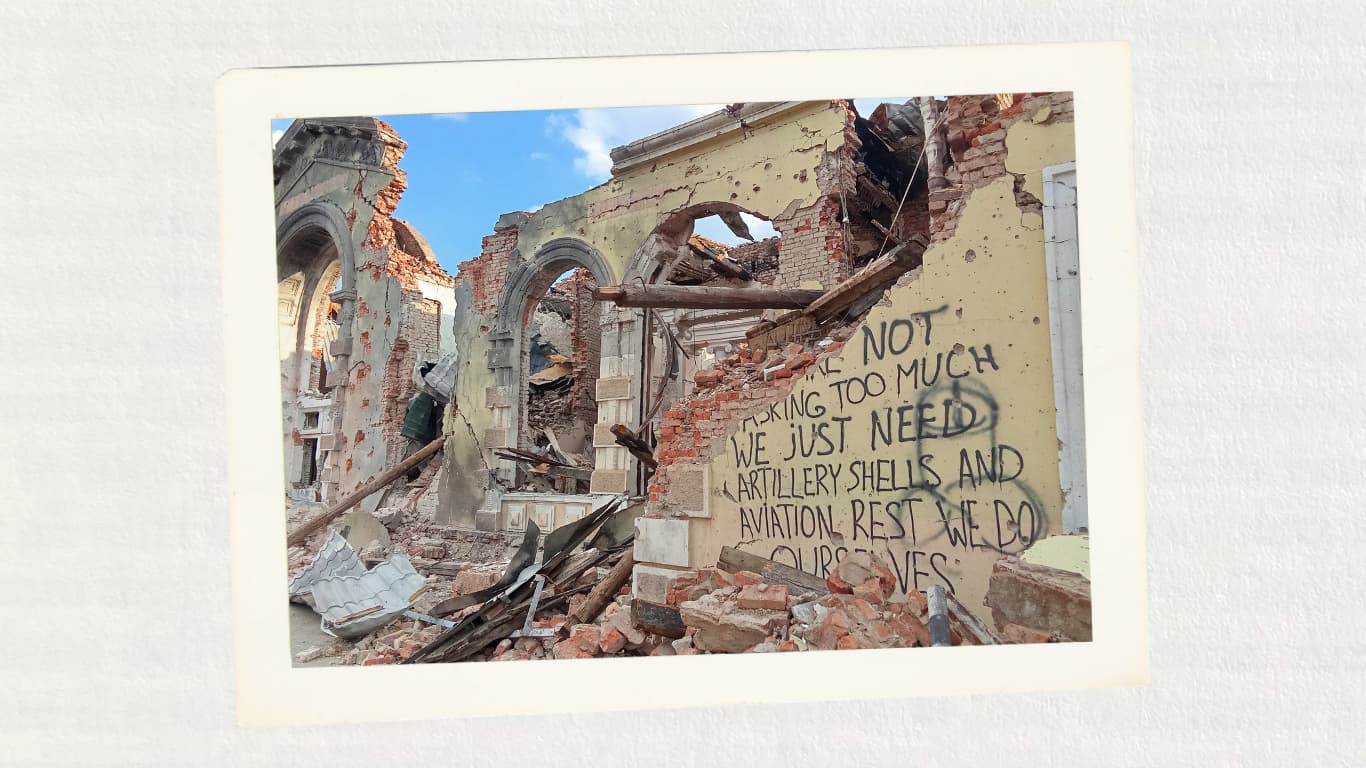
While volunteering in Sloviansk in 2023, I met a Ukrainian soldier who previously served in Afghanistan. Not many know, but Ukraine supported the allies as a ‘Non-NATO contributing nation’, and when Kabul fell, one day after the suicide bombing at the airport gates, it was Ukrainian Special Forces who went out on foot into Taliban-controlled territory to escort a convoy of Afghan interpreters back inside.
I asked Alex how I might better help Ukraine. His suggestion surprised me: ‘Teach our soldiers English.’ His idea was that they needed something to look forward to after the fighting stopped, and their best skills now were as soldiers; they could apply their combat experience in security jobs abroad, as he himself had done in Afghanistan.
I was considering this when, weeks later, I watched as a Russian missile hit a block of flats, flipping the roof into the air like a coin. I was one of the first on the scene. 15 civilians died, including a two-year-old child.
I can still hear the woman screaming from the street as I climbed the stairs to help. There was no sound up ahead.
Not only did I forget about teaching English, I stopped donating to the Ukrainian army, instead paying for the skills I would need to help in the fight. I guess you could say it was hubris to think the words I saw on the ruins of the Kostyantynivka train station did not apply to me: ‘We just need artillery shells and aviation. Rest we do ourselves.’ Or perhaps after Sloviansk, I was one of the selves.
The Ukrainian Army is a very different entity now. In March 2026, Ukrainian military experts were asked to meet leaders of UAE, Qatar, Jordan, and Bahrain to advise on the 800 missiles and 1,400 drones Iran had hit them with in response to US-Israel attacks. The meetings resulted in high-profile defence contracts to supply a new breed of Ukrainian interceptor. Zelensky’s reaction was humble, but he knew it was a milestone. Ukraine was no longer alone in needing help from the world—the world now needed help from Ukraine. When asked if the US would seek Ukrainian support also, President Trump offered implicit recognition of this shift: ‘We don't need their help in drone defence,’ he said. ‘We know more about drones than anybody. We have the best drones in the world.’ Whether hubris also, this statement ignored something else—that the Russia-Ukraine conflict had upended the economy of war. ‘Best’ with weapons now means many of good enough.
The European Defence Dilemma
For Europe, the constellation of Russia’s new belligerence and the nebula that has emerged over US-EU security relations leaves our leaders with straws to pick and a fortress to build. The challenges around rearmament could not be more Alpine:
Our armies are institutionally undersized. With the fall of the Soviet Union, 1990s NATO abandoned the 1970s maxim: quantity-is-quality. A Bush official explained, ‘There are no more threats to NATO from within Europe… NATO needs an expeditionary force, a strike force that can move fast.’ Yugoslavia, Libya and Afghanistan would be cited as examples. Long before defence cuts brought rust to our force-readiness, we had dismantled our capacity to deal with invasions the size of Russia’s on Ukraine.
Drone warfare demands more change than our commanders will admit. ‘Legacy platforms are not obsolete’ insisted a NATO Admiral months after those legacy platforms supported 16,000 troops from 12 NATO countries during exercises in Estonia and, upon maneuvering, were immediately ‘eliminated’ by Ukrainian drone teams. Tanks remain at the backbone of Western brigade formations despite being used with extreme caution in Ukraine for fear of becoming big game in the cheap drone safari. Now that Ukrainian ground drones can take and hold trenches and FPVs provide precision artillery, it begs the question: when will our faith in tanks begin to compare to our faith in cavalry after WWI? And where is the Russian Navy?
Fighting-age Europeans do not want to join the army. A 2025 survey showed that while most EU countries supported an increase in military spending, 18-29-year-olds were against conscription. Another showed only 22% of Poles would volunteer to defend their country if attacked. I have not seen a survey on how many Poles would fight if Finland were invaded.
Rearmament is expensive, and everyone is broke right now. An estimated 250 billion extra euros will be needed every year to deter a Russian attack on the EU. This would afford 300,000 soldiers—a Spartan number considering the 1.5 million fighters in the Russian army, many of whom are no strangers to combat. Don’t rely on me to tell you how important it is for soldiers to have seen combat—ask Alex, or any frontline infantryman.
Would it be so wrong to say that Europe wants to build an army it cannot afford, on platforms that are less relevant, to support soldiers who do not want to fight? While Russia’s army is five times larger than 300,000, with drone production and experience that is unmatched.
Unmatched that is, except for Ukraine.
The Cossack Precedent
Some five centuries ago, Europe turned to the Cossacks to protect its borders from Ivan the Terrible’s Russia. It would be romantic to apply that historical precedent today—but the rhyme is irresistible.
In halting, even reversing Russia’s invasion, Ukraine has done more than superpowered asymmetric engagement—one might say it has also reshaped war. How else do we interpret Iran’s parity in negotiations with the US? Having driven the Russian Navy out of the Black Sea, Ukraine is now penetrating the air defences of Moscow and St. Petersburg ‘like it is our territory’—while its ground drones are not only taking trenches but prisoners too. Thanks to the gamification of tactical drone operations, where strikes translate to ‘e-points’ that units can spend on an Amazon-like website for new weaponry, the drone innovation cycle has shrunk to 4-6 weeks.
4-6 weeks. The goal of NATO’s Rapid Adoption Action Plan is to compress development cycles to 24 months. As a former RAF Commander noted, Ukraine has also changed the face of military development: ‘the age of drone and electronic warfare demands a new model of defence acquisition: one built for speed, innovation and industrial scale.’
The EU fetes Ukraine with a flurry of manufacturing deals designed to reinforce our armies; and yet, in buying Ukrainian drones, are we not guilty of the same hubris as Trump when he said the US does not need them? Is there not much more Ukraine can offer us as an ally?
Peacetime
The Russian leadership will one day have no choice but to accept a truce. On that day, the pace of Ukraine’s defence innovation will slow from the gallop of today into a steady trot, and many of Ukraine’s 900,000 war-honed servicemen and women will turn from the battlefield.
It was a mistake when the Polish-Lithuanian Commonwealth failed to reward the Cossacks for their service four centuries ago. It would be a bigger mistake if we did the same today. Inclusion into NATO or an EU defence alliance should be mandatory, but would it also be unimaginable to erect Ukrainian bases beside our American ones as a deterrent to Russian aggression?—in the Baltics? Scandinavia? Germany? Great Britain?—and towards that end direct our billions of euros? Ukrainian innovation cycles could continue at a gallop if we introduced ‘e-points’ competition to military exercises. Ukraine’s army has the data to make wargaming real. The Americans could come play as well. Bring along some of their drones.
Even if this were impossible for reasons our admirals could explain, we would do well to examine our praise of Ukrainians—check there is no hubris hidden away.
And to Alex: maybe there is a reason I never got round to teaching Ukrainians English—and that’s because it is we who should be learning Ukrainian.