
When I close my eyes, I dream of drones
Since childhood, I have had long, vivid dreams — fragments of daily reality, shattered and reassembled by my impressions, fears, desires, and anxieties. I still remember some of them. For years now, I’ve kept a dream diary, systematically documenting the unconscious that only night could reveal. But Russia's full-fledged war marked a turning point: my dreams grew sharper, often dystopian and surreal. Now, I keep the dream diary on my bedside table, reaching for it in the haze of half-sleep to capture the smallest details — the textures, the tastes, the smells, the feeling.
I often dream of Russia, gloomy and liminal, with its fragmented temporalities and shifting spaces that feel dystopian. I open my notebook and read the diary entry from 20 May 2024, when Russia attacked Lviv with Shaheds:
Today’s night I had a horrendous dream. I was obliged to fly to Moscow on a rocket’s tail. The flight was loud,
almost deafening. I showed my passport on board, but it
was torn apart. Upon arrival, Moscow was foggy; the fog
was bloody red and heavy. Sirens went on and off, and a
weird corporate-America-like man was projected into the
sky. In Steve Jobs' manner, he was spreading
authoritarian messages with a haunting smile. I was
hungry, but I could not buy food or anything else, as I
did not want to support an economy that fuels mass
killing. Still dreaming, I heard a loud siren as the sky
started to dazzle and darken. It was a real siren, howling
in Lviv. The next thing I heard were the sounds of the air
defense system as the Iranian drones approached the
city. The dystopia I witnessed in my dream was outside
my window, loud and annoying.
Dreaming is deeply personal — yet, in times like war, it becomes collective and political. Each stage of the Russian invasion has brought with it new dreamscapes and metaphors. Benedict Anderson’s idea of the “imagined community” becomes, too, a “dreaming community,” one bound by recurring dreams of air alarms, shellings, and unrelenting anxiety for loved ones.
***
I began dreaming of the new stage of this old war before it started. In January 2022, disoriented and suspended in anxiety, I had recurring dreams of tanks rolling through the streets of my remote mountainous hometown, Kosiv. In 2023, after air defence hit a rocket just above my head while I was crossing the street on my way to the railway station in Lviv, I dreamt of rockets. Each time they reached me, I would wake up with relief. It was just a dream.
Now, when I close my eyes, I dream of drones. They arrive in swarms, like bees, and explode one by one. In search of shelter, I enter strange buildings — old psychiatric clinics, local wooden museums, abandoned houses.

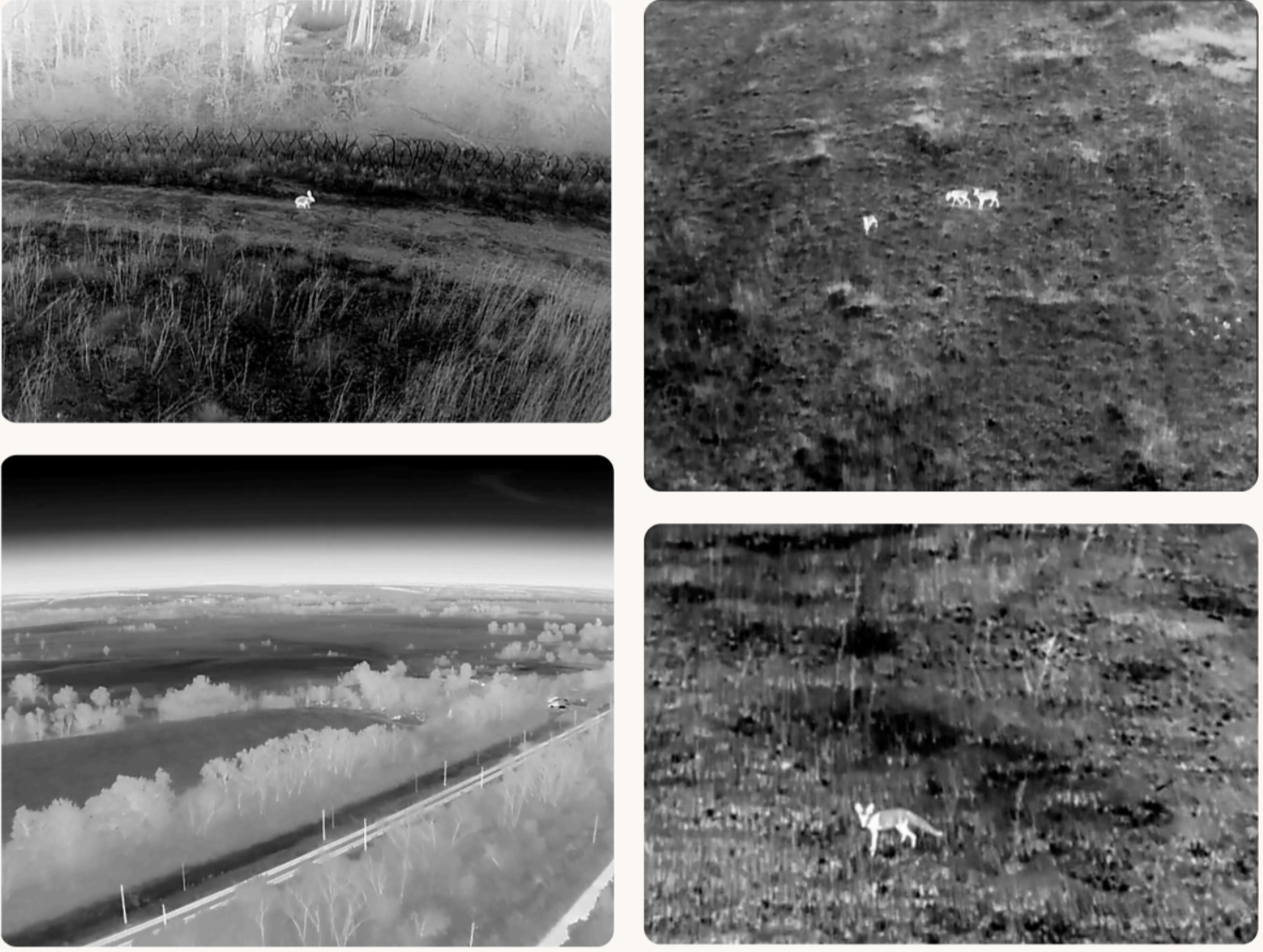
I enjoy guessing what kind of animal I spot in the footage from frontline fields — videos my partner, a soldier and DJI Mavic 3 pilot, regularly sends me. The image flows both smoothly and vividly, guiding my gaze across the forest-steppe landscape of the Kharkiv region teeming with grass,
insects, plants, and flickers of animal life — a rich complexity of non human habitats. This is the closest I can come to witnessing these places, now sealed off from civilian eyes because of their proximity to the battlefields.
I wonder if Russian soldiers see these animals too. Do they notice the softness in the way a fox moves, the playful leaps of a rabbit, the graceful sprint of a deer? How is it possible to aim and destroy after witnessing something like this?
Ukrainian soldiers must aim and destroy as well — but to defend, not to conquer. It is one of war’s deepest paradoxes. Unlike Russians, who invade and grab land that is not theirs, Ukrainian soldiers have no choice. I often think about how drone footage marks not only the altered state of warfare — but also our ways of seeing, our visual sensibilities. These images shape how we imagine the landscape of this war: captured from above, reflecting the black-and-white warmth of thermal imaging, or the “sublime” of destruction — craters left by KABs, Russian precision-guided bombs.
The landscapes of war zones are now primarily narrated and represented through drone footage. In much of Western scholarship, these images are interpreted as the gaze of the perpetrator — of dominance and control, the eye of the state or empire that surveils, disciplines, and invades. In both media and visual studies, theories of the gaze are rarely written from the perspective of a defender. More often, they emerge from the vantage point of the coloniser, a perpetrator. Drones — deployed predominantly by global powers such as the United States, China, Russia, Iran, India, and Israel — embody a new form of neocolonial vision. “The Israeli military has been altering commercial drones to carry bombs and surveil people in Gaza,” I read in Al Jazeera, in an article detailing how DJI drones are used to destroy humanitarian aid and kill civilians. Mavic drones are now used in Gaza and the West Bank to surveil and then target people’s houses. I am still not sure what to do with this. Morally. Russian and Ukrainian forces, too, rely heavily on drones — for surveillance, for precision strikes. Now, it is the most common way to be killed at the frontline.
The Russo-Ukrainian war offers an opportunity to think differently about wartime landscaping. Even in times of constant violence, one can nurture and express closeness to place, through the image or otherwise. The gaze of the Ukrainian drone pilot is the gaze of the defender, not an aggressor. Most of our armed forces are made up of people who were civilians until recently — workers, farmers, artists, activists, pacifists, poets, and theatre critics. We experience this war through their documentation, having little access to the spaces they now inhabit, that would not see otherwise.
Recently, my dreams have been shaped by drone visions: I fly over dreamscapes I have possibly seen in footage sent from the war zone. It’s an entirely different register of experiencing the landscape — not the close, intimate encounter marked by the privilege to touch and smell, to remain earthbound. I wonder if this scale will ever shift. Will I ever see these landscapes with my own eyes? Will there still be things left to see — trees to hug, flowers to pick? I keep wondering if it's possible to love something so distant and remote.

For my last birthday, I received a lily-of-the-valley flower, carefully pressed and dried between the pages of Orwell's Homage to Catalonia, picked in the forest just a few kilometres from the frontline. Now pressed between the pages of a biographical book about Lesya Ukraїnka, this flower has become more than a gift — it is a fragment of a landscape I cannot reach, a piece of earth that war has made distant yet, paradoxically, intimate.
Pictures from a private archive, taken in the Kharkiv region.