
Embodied Luxuries, Interrupted
I was standing in the shower, washing my hair.
I squeezed the usual amount of shampoo from the bottle into the palm of my hand and then massaged it into the tangle of wet hair on my scalp with both hands. My fingertips ran between the strands of my hair. Droplets travelled down my body, gathering at the bottom of the shower stall before disappearing down the drain.
And then the lights went out. Cold water started to flow.
I quickly rinsed off the shampoo, dried off, and went to check what had happened. The power was out in the whole apartment. I figured the outage extended throughout the street, perhaps to preserve electricity for hospitals and other more essential places.
The power outage triggered a stream of thoughts about how the war affects the everyday details of physical existence. How do you wash your hair when the power can go out at any time and it is unclear how long the outage will last, because anything can happen? How do you do your laundry? How do you treat your computer and phone batteries — do you constantly recharge them as a precaution? How to shop for food when you can’t rely on the fridge and freezer? And how to cook? How to go for a run when you must stay close to a shelter at any given moment in case of a ballistic attack? How to make love?
In the event of such an attack, how to deal with the inner panic and anxiety that — at least for a time — become your faithful guides and never leave you for a moment? How do you cope with the deadly fatigue that increases with each night spent in the shelter and an adrenaline-fuelled state of mind?
I believe that many Ukrainians asked themselves similar questions at the beginning of the full-scale invasion. But those of us who are lucky enough to have Ukraine buy us time — who do not face Russia’s extermination attempts — don’t see these questions. Ukrainians have gotten used to them and no longer write about these banalities, because problems like “how to take a shower” have become about the 356th most unpleasant circumstance of the war. The death of loved ones, the threat that their country may cease to exist — or that, under occupation, they might be tortured and raped — occupy more prominent positions in the hierarchy of body-related problems. Like the danger of being abandoned by those who don’t understand.
It was important — and extremely enriching — to experience it. I wish everyone who looks away or says “it’s complicated” could experience it: that everyone could be in a place where Russia is challenging their ontological security, bare existence, and things we perceive as laws of physics. To see how their body reacts to the sound of air raid sirens. How they react to explosions when a drone strikes nearby, and vibrations when a ballistic missile lands in the city. Because it helps one understand what is at stake, Russia’s escalating tactics of terrorising civilians across the country, and the attitudes of Ukrainians toward the war.
*
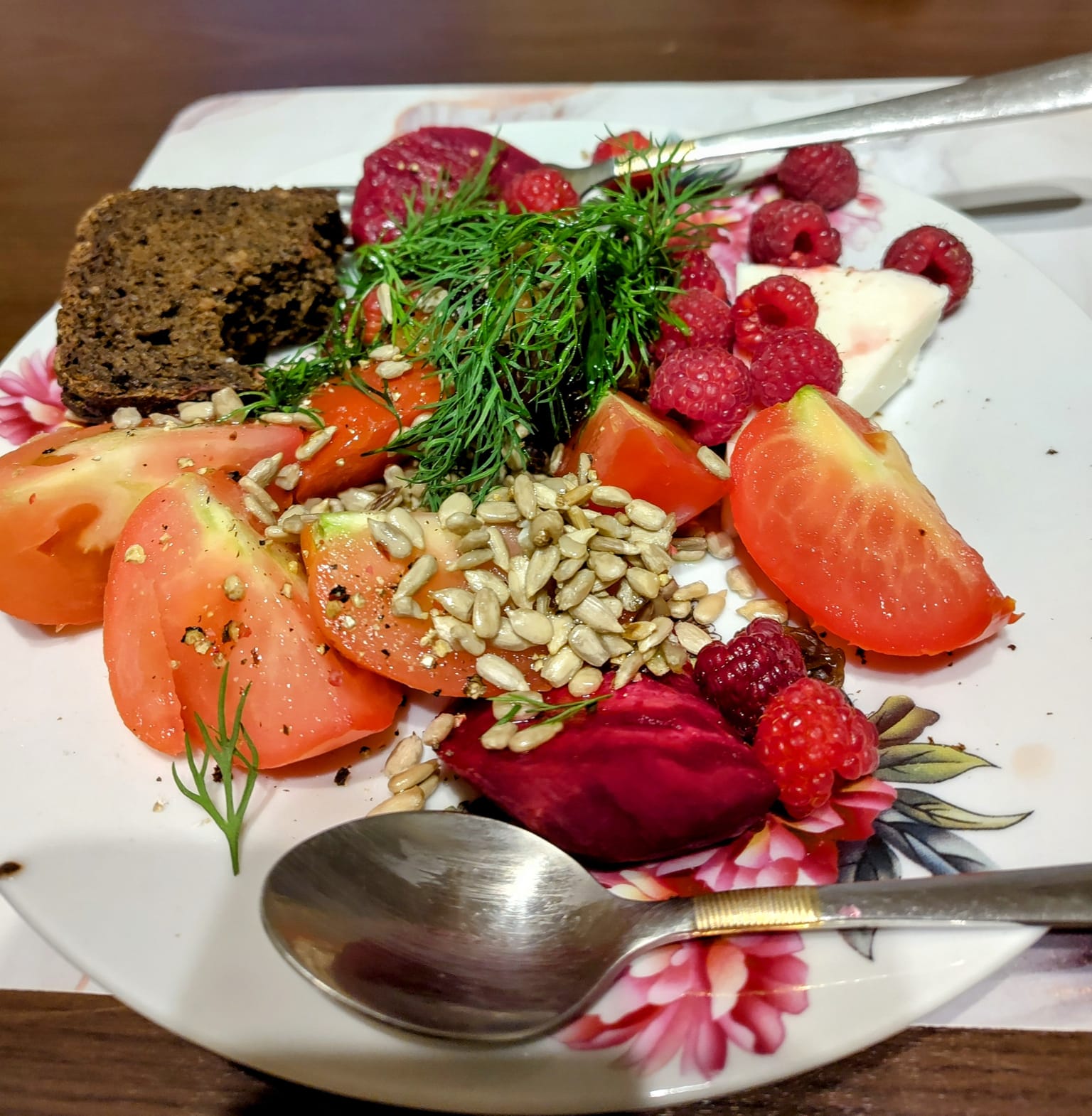
While wondering “how to wash my hair” and asking all the banal, everyday questions, I noticed that I was taking care of myself. I dried my cold hair and made myself a colourful salad of beetroot, tomatoes, watercress, goat cheese, dill, and raspberries — ingredients I had bought earlier at a local supermarket and which I was craving. I garnished the salad with a sprinkle of freshly roasted sunflower seeds. I returned to my body, to the basics. I bought sunflowers and orange organic wine at the market. In eateries and restaurants, my partner and I enthusiastically sampled and enjoyed different versions of syrnyky, deruny with mushroom sauce, and various adaptations of beetroots and meats. For the first time in my adult life, I didn’t think of food as necessary fuel, but experienced it — spontaneously — as a sublimation of love for life and for others. Without much thinking, I prepared Czech specialties for my friends: kulajda, potato soup, goulash, potato pancakes. We shared food, beer, and wine; they embodied care, awareness of one’s importance, and appreciation for life.

I came back crying, too. My body, startled by its own forgotten authenticity, managed to cry after a long time.
It cried often. Like whenever a military funeral convoy passed by. At those moments, time ceased to exist. Whatever the passers-by were doing, they dropped everything, became silent. Stopped. Some knelt. Their bodies became part of an affect-laden moment; gratitude, respect, and pain materialized in the form of kneeling, standing, silent, and feeling beings — a collective body that slowly moved through the city as the convoy passed from the church to the cemetery.
*
In the Czech Republic, and perhaps in other countries, people wonder how Ukrainian women can take care of their hair and nails when their loved ones are fighting at the frontlines. How can they – how dare they?
I understood. Food, hair, fashion, sensory pleasure, and sharing are not superficial. Enjoying them, taking care of someone else’s body — and your own — is taking care of life itself.
Even washing my hair has become something else. I always squeeze a little shampoo from the bottle onto my palm and massage it into the tangle of my wet hair with both hands. It’s a luxury to wash my hair. It’s a luxury to run my fingertips between strands of hair and enjoy the smooth substance. It’s a luxury to have a body with droplets of water running down it. It is a luxury to have a head and to have hands with which you can massage its skin and enjoy the slight tingling of your skull.