
Conversations about an open society and a shared future: Poltava to host Ukraine’s first ‘Ganok’ Democracy Festival
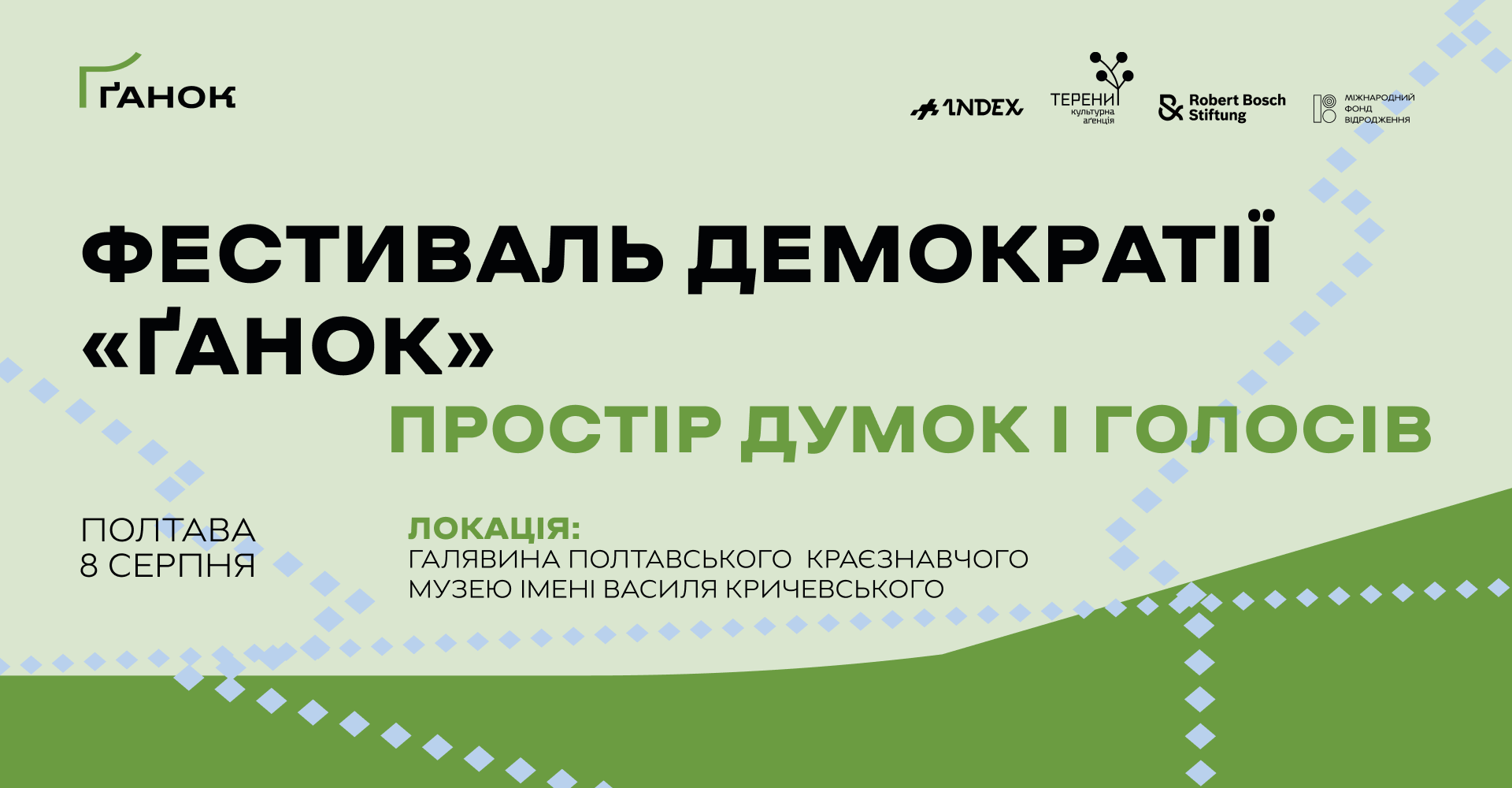
What is ‘Ganok’?
The ‘Ganok’ Democracy Festival is a free and open-to-all outdoor event dedicated to discussions about democracy, politics, civil society, culture, memory, and our shared future. The speakers include Ukrainian and international public intellectuals, writers, journalists, and civil society activists.
Among the formats are panel discussions, a public podcast, workshops, an installation featuring the voices of Ukraine’s indigenous peoples, a guided tour of the Poltava Local Lore Museum, a ‘living library’, music, and food courts.
According to the organisers, the festival’s name, ‘Ganok’ (which translates as ‘Porch’), refers to the image of an open threshold space that is deeply rooted in Ukrainian tradition:
It is a place between the private and the public, between the home and the street — a place for a lively, accessible, everyday dialogue
This year, the event is organised by INDEX: Institute for Documentation and Exchange, a cultural and research centre dedicated to documenting the war and fostering international exchange, and the ‘Tereny’ Cultural Agency, a non-governmental organisation that develops, preserves, and promotes the culture of Ukrainian regions.
From the back of a lorry to large-scale festivals
Democracy festivals as a format of public events originated in Sweden in 1968 in the town of Visby, where the then Minister of Education, Olof Palme, delivered a political speech from the back of a lorry. Today, democracy festivals from various countries are united in the Democracy Festivals Association, which includes Northern Ireland, Norway, Sweden, Finland, Denmark, Estonia, Latvia, and Iceland.
Today, democracy festivals from various countries are united in the Democracy Festivals Association, which includes Northern Ireland, Norway, Sweden, Finland, Denmark, Estonia, Latvia, and Iceland.
Last year, I was fortunate enough to visit the town of Cēsis near Riga, where the Lampa Conversation Festival takes place outdoors, right around a medieval castle. I realised that Ukraine must appear on the European map of democracy festivals because we are fighting for democracy in an existential clash with an authoritarian enemy. At the same time, we need a platform to foster understanding between civilians and the military, Ukrainians and foreign allies, life during the war and the political imagination of the future
notes Sasha Dovzhyk, Director of INDEX
To be recognised as a democracy festival, events must adhere to the principles defined by the Association: they must benefit participants and society at a national level, be free of charge and open to everyone, work towards participatory democracy and the public good, focus on civic engagement, participation, communication, and interaction, have no affiliation with any political party or group, and in format and spirit, be a festival rather than, for example, a conference.
In 2026, the event will take place in Ukraine for the first time, hosted by Poltava — a city of exceptional cultural and historical depth. At the same time, as stated on the event’s website, Poltava is currently on a journey to reclaim its own identity and needs its local voices amplified.
The added value of European democracy festivals is that most of them take place in smaller towns and cities rather than capitals. In this way, they create opportunities to strengthen and discover regions — highlighting both their unique contribution to state development and the challenges they face today. Holding the first Democracy Festival in Poltava is, in particular, an example and a call to bring vital cultural formats to cities that receive less of our support and attention. Our task is also to introduce Ukrainian and foreign guests to the history, culture, and key actors of the Poltava region, so that this introduction to the region eventually grows into new initiatives and partnerships.
says Tetiana Teren, Head of the ‘Tereny’ Cultural Agency
Festival Programme
The programme will run throughout the day on 8th August, from 12:00 to 22:00.
Among the participants are:
Mykola Kulchynsky, Ukrainian dissident and public figure;
Vakhtang Kipiani, historian, journalist, and serviceman;
Lena Chychenina, cultural commentator;
Yuliia Tymoshenko, journalist and media manager;
Refat Chubarov, chairman of the Mejlis of the Crimean Tatar People;
Jason Liu, Taiwanese journalist, and many others.
The evening will conclude with music and poetry by Oleh Kadanov, a military serviceman and member of the bands Orchestr Che, Liniya Mannergeyma, and Mantry Keruaka.
A detailed programme is available via the link.
How to participate
Participation in ‘Ganok’ is free of charge (excluding the food courts). To attend the festival, please register on the website: https://ganokfest.com/#register
The event is supported by the International Renaissance Foundation and the Robert Bosch Stiftung.